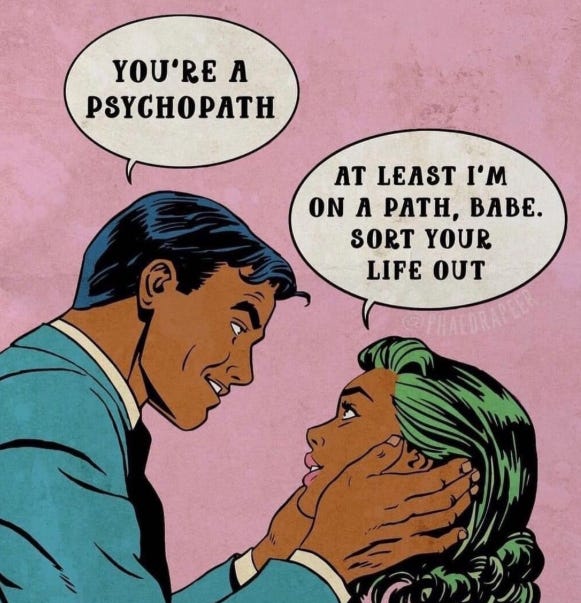
Interviewing a Psychopath
I saw an opportunity to ask some questions, and I took it. Even now I remain unsure if it was a good idea...

Substack is full of bullshit, but you already know that. You’ve seen the AI slop, the softcore Sirens, the sellers, the self-helpers, the social keyboard warriors, the self-important, and the sarcastic.
I sat down with a psychopath.
No questions were off limits.
How did I get here?
I could simply tell you that I saw “A psychopath’s journal” in my feed and decided to reach out, but I’m a writer after all, so allow me to elaborate.
Seeing the title, I immediately had questions. My first assumption was that either
The author is playing a character to drive engagement, or
The author is calling themselves a psychopath, but not meaning it literally
I figured I could spot a faker by their work, so I dove in.
I read the first 11 posted articles and tons of notes.
The writing was cold and analytic, and included some poetry. (This led to more questions- what the fuck is a psychopath doing writing poetry? I mean, ChatGPT can write poetry too, but if it became sentient and was making decisions all its own, I wouldn’t expect it to create a substack and write poetry, ya know?)
The capacity to experience emotion and the depth of empathy required to relate to a lot of poetry I thought would preclude a psychopath from finding any interest in it. I read on.
The pieces described trying to navigate a world by reading context clues and attempting to blend in. It was strangely relatable, as I imagine it’s part of the human experience to “not fit in”, but for the author these exchanges weren’t uncomfortable and embarrassing- they were training.
Every human interaction interpreted like algorithmic data, allowing the interpreter to then make subtle behavioral adjustments that allow them to better blend in. I imagined the internal dialogue of such a person is probably strikingly similar to a wild animal being introduced to humans for the first time- sniffing, observing, reacting. Stomping, observing, reacting.
Biting, observing, reacting.
Each lesson the animal survives making the humans less of a mystery, less of a threat.
I developed so many more questions.
I read on.
I had to know more.
I was hooked.
The questions I had demanded answers.
Eventually it occurred to me that I could just ask. Substack as a platform is all about community and connecting with other writers, and the worst they could do is ignore me or say they’re not interested, right?
So I reached out.
I slid into the DM’s of what I now considered a fairly credible sounding, self-proclaimed psychopath.
(Thinking about that now as I write it, I’m realizing that probably says something about my own psychology.)
After an introduction and brief pitch, it was set.
I, with no formal education in psychology, and no significant interview experience to speak of, had won myself an audience. The only problem- I had no idea who or what I would be interviewing.
What I did and didn’t expect:
I guess I expected Ted Bundy. Clever, witty, and ruthlessly aggressive.
I expected to immediately have a sense that something was different about this person.
I expected to feel manipulated.
I expected something eerie. Something potentially terrible.
The thought of it excited me. I made a long list of questions, and I tried to mentally prepare myself for their responses.
Now with the interview over, I can tell you I didn’t feel any of those things. She didn’t strike me as evil, or dangerous, or even all that dark. The conversation was, I hate to admit- almost boring. And that’s not to say she didn’t have plenty of interesting things to say, but just that the archetypical psychopath I had imagined never showed up. The person that did was just like the rest of us- meandering through life playing the hand they were dealt, and hoping no one notices their differences.
In some ways however, she was as expected. She presented as quite intelligent (studying medical engineering), and wasn’t lacking for charm or wit. Our conversation felt honest and intimate, after all she was sharing with me details about her inner-workings- secrets she’s kept from the rest of the world.
“I consider myself a “pro-social” psychopath and very controlled… …I was extremely explosive in my younger years, but I learned impulse-control at an early age and that has helped me immensely to blend in with society.”
What I learned:
Her origin story starts the way you may have guessed, although she’s fuzzy on the details or at least not super comfortable sharing them with a strange man on the internet.
“Perhaps part of my psychopathy stems from (childhood) trauma… I didn’t have a single safe person…”
“I had no autonomy, I was held captive, couldn’t escape. The main trauma is basically the loss of control. It is possible that the psychopathy developed as a defense mechanism, but even if, due to my genetics, the two forces amplified each other.”
“If the CPTSD (Complex Post Traumatic Stress Disorder) is the wound, then the ASPD (Antisocial Personality Disorder, IE: Psychopathy) is the protector.”
But that’s only part of the story. She was hyper self-aware and had spent a lot of time introspecting on what made her, her. Eventually, she started to put all the pieces together.
“I’m a combination of both factors. The nature part only amplified the nurture part.”
So what does a psychopath do once they realize they’re not like everyone else?
Initially, it was a game of adaptation and camouflage. Hilariously, she found the “how psycho are you” tests she found on social media to be useful training material for how to behave so no one suspects you.
“I used (those tests) to derive behavioural rules and how people work and perceive. it was like a start-jump into humans, a first step into understanding the laws of humanity.”
I found the answer to my poetry question to be similar.
“Poetry was my entry drug to writing, journaling, developing awareness and depth. Understanding human emotions and how they work… …It seemed to me like a concentrated version, which appealed to me out of pragmatic reasons… …It helped me both ways: to understand the input from other people, but also apply language more efficiently as an output.”
She approached reading poetry as a research opportunity into the emotional human psyche. Here is someone incapable of experiencing the strongest of human emotions at the level that most do, and as a result she’s looking to poetry for better descriptions of them. This was where the first bit of sympathy crept in. It was all very confusing, because why should I feel bad for her when she’s not in any way sad about it?
The dark stuff:
So what does all this say about her? Is she a monster? Well, certainly not in the eyes of the law. She’s been very careful to curate a clean record, and stay within the boundaries of acceptable behavior, even though as she puts it, it’s only because it would be a hassle not to.
“I don’t have a moral compass, nor principles that are fixed. I simply vary my narrative, depending on the context. In the eyes of the justice system and police, I have a perfectly blank record.”
“If you fuck up once, you fuck up your record for life and will suffer from the consequences until the day you die. It doesn’t make sense, the calculation is not profitable for me and that’s all that matters.”
If keeping within the accepted societal norms is the only thing stopping her from acting out on impulse, does that make her a ticking time bomb? What happens when she’s tempted to cross a line, and is all but certain she’ll get away with it?
“The more you consume, the more you will need to hit another high. Same goes with my bad behaviours. I know I would need more and more if I just let my impulses take over. A month later I’d be in jail. So I developed the habit of making such things something “special” and to be consumed with care. Adaptation startegy. which also works in the favour of society, but that’s just a side-effect.”
I know you just read that last line and are wondering, “what bad behaviors?” Sadly, like most psychopaths, abusing animals or “experimenting” on them is a part of her story.
“I had enough restraint to not push it too far, again I didn’t want to get caught and deal with the shitstorm and everything… …It was a precarious dance on the lines”
I didn’t get into too many specifics on the animal abuse, because frankly, I wasn’t sure I wanted to know. I did ask the largest animal she experimented on however- horses.
“A dog will attack you, a horse will run away and be scared of you. makes it actually very easy to abuse.”
Despite this experimentation in her past, she actually claims to love animals in her own way.
“I love animals. I really do. I can treat them very well too.”
She was clear that she hadn’t done any such experimentation on humans… Although she later did confess that she has spent some time thinking about it.
“I haven’t “experimented” on humans in this way… …It does intrigue me, and I play in my mind with different scenarios and ideas, but I know not to execute them, if I want to preserve my personal freedom… …I can vividly imagine what I would do, even to the smallest details, but then I just conclude with the conscious decision to not do it.”
Is it weird that my mind conjures up a jail-broken iphone? From the outside it looks just like any other phone. Even if you took it apart piece by piece you would not find a smoking gun to suggest anything different. Yet, she is capable of incomprehensible things, things most of us would be haunted by if we could bring ourselves to do them at all, and then she can just- walk away and be totally fine.
“I can befriend someone in a matter of weeks and make that person’s whole day revolve around me and I will take and take and take until I have no use anymore or the benefit I get decreases. Then I simply vanish and drop that person. No record, no tracks, no way to get back at me, I got away with it.”
“I don’t “feel” when I crossed a boundary or hurt someone. I am emotionally oblivious to such things.”
So what is it like to be her?
“I’m a “freshly aware” psychopath and also the diagnosis is relatively young, so I still have a bit of learning about myself to do too.”
Are there advantages?
“I don’t experience emotional breakdowns the way I observed in other people. I don’t have anxiety, I don’t have self-doubts, no regrets or guilt that eats me from the inside, no blaming myself, low fear, I don’t feel overwhelmed, I don’t have mood swings or anxiety, etc.”
I’m sure some of you are thinking, “that sounds like bliss”, but I’m not so sure. On experiencing joy:
“It’s very difficult to say that there are things that reliably bring me joy or entertainment. Joy is again an emotion that I only possess in fractions. I can feel joy, but it is very limited in the sense, that it lasts as long, as I ‘feed’ it with attention and cognitive resources, to tune into the emotion. It’s comparable to searching a specific frequency on a radio. The knobs are directly connected to my emotions and I kinda turn them in my head until I find the right tone. Then I can spend some time there, but I lack the part where the emotions leave trails or linger. If I turn my attention to something else, gone is the frequency and the only thing I get is noise/static.”
So does she do anything for fun?
“I enjoy doing martial arts, but if I had to stop doing it, I wouldn’t mind.
I enjoy every other sport as well, but martial arts also helps regulate my predisposition for aggression.”
“I like action, boredom is my enemy. if you are someone that does interesting things, that person becomes interesting.”
You could also say she has a ‘passion’ for learning, but then even that is driven by a need for power and control.
“Everything that I don’t know much or nothing about, automatically interests me, because knowledge is power.”
How she views on other people:
“People close to me are important to me. While it is true that I see people as npc’s, not even those important people are automatically excluded from that. I put effort into seeing them more as another person. But in a way I consider them as a possession, as something that belongs to me and I am / can be very protective of what’s mine.”
And how the NPCs view her:
“For some reason people like to vent with me, I’ve had often people emotionally open up to me. Oftentimes, i get positive feedback that my inputs really helped, that they felt listened to… …that they felt safe.”
And now, the lightning round, or ‘everything you wanted to know about psychopaths but never had the opportunity to ask one’:
Does she believe in God?
“No not really. I‘m more of an agnostic.”
Internal monologue?
”I’m having a discussion in my head with myself as we’re talking!”
Can she spot other psychopaths?
“I have several suspicions and sometimes I can sense when someone is “off” in a similar way i am, but I never know for sure.”
What would your significant other say is the strangest thing about you?
“Sleeping with a 26.5 lb blanket over the normal blanket at night”
Does anything scare you?
(I) wouldn’t know (of) something that can reliably scare me.
What does an ideal date night look like to you?
“Probably something illegal and completely fucked up.”
Any pet peeves?
“Inefficiency and boredom are for sure top tier here.”
Reflecting:
Thinking back on it, it may have been reckless.
Imagine me, an average suburban Dad to young girls, finding out news that a psychopath lived in the neighborhood and thinking, “Gee I think I might knock on their door and ask them some questions!” What could go wrong?
Fortunately for me, the person I met didn’t appear to be Ted Bundy. She was clear, articulate, vulnerable, and easy to talk to and work with. And maybe that’s what makes the feeling I get all the more unsettling. Publicly, she is just like any number of other people I’ve spoken to. She was actually MORE pleasant than many. Internally however, she’s having a very different human experience.
She wasn’t emotionally hardened.
She was emotionally incomplete.
Maybe that’s why I can’t help but feel bad for her.
Or maybe I’m being manipulated more than I realize.
“Sometimes I do some mental gymnastics and imagine I’d probably be the abusive ex you keep running back to.”
She was once someone’s newborn baby, full of hope and wonder. Infinite potential.
Then she suffered trauma so devastating to her psyche that a part of her seems to have simply shut down.
She’s since filled in the gaps best she could with literature, media, and a sort of algorithmic trial and error process she plays out during human to human interactions, but that’s all it can ever be for her.
The mask she wears, constructed of the intricate details that she’s amassed in her mind of what she’s “supposed to” be feeling, she wears for everyone else.
She has lived her life since childhood disabled in a very real way. Lacking an otherwise universal human sense. She can see, smell, taste, hear, and feel, but it’s all just data collection. She won’t be moved to tears by a song, or be lost in an emotional embrace, or feel devastated by heartbreak.
I had to ask her if she saw this all as a net positive or net negative, because there’s no way I can see it as anything other than a severe mental disability.
“The way I can handle and use it now, it is a superpower.”
And THIS is the crux of the tragedy.
She doesn’t even have the ability to mourn for what was taken from her.
She would likely see that as nothing more than a waste of time and energy. Yet what was done to her appears to be permanent.
You could say a part of her humanity died all those years ago.
There is no book, no training, no medication, no cure.
But even if there were, she wouldn’t be interested.
“So even if I could, I would not flip the switch. Sure, it would be interesting to experience for a day or two, to see some things for myself, confirm suspicions/conclusions of my analyses, etc., but to give it up completely?
Never.”